Raava
A proposal for iShoes.
Ninety days.
What is happening to your sales, what is wrong on your shop, what we would change, what it costs, and what we think happens after that. Every number in here came out of a system you already own, and every page tells you where to look.
How to read this
- One idea a pageA picture carries it and a few words label it. If a page needs a paragraph out of you, we have written it badly.
- Check usNearly every page ends with a line telling you exactly where to look in your own Shopify, your own Google Analytics or your own Omnisend. Most take under a minute.
- Nobody did anything wrongEvery problem in here is a job that was never given to anyone. None of it is a person and none of it is your team.
- Three kinds of numberA solid mark is measured out of your own systems. A hollow mark is where we think a number of yours can go. A bracket is two of your own numbers put together, with both of them printed beside it.
- What we will not sayNo percentage of confidence, anywhere. A percentage of confidence means somebody sampled a hundred businesses like yours. Nobody has.
- MoneyAustralian dollars throughout. Where a cost is in United States dollars it says so, because we have not fixed an exchange rate and will not guess one.
- RefundsEvery figure for what your shop sold is what a customer ordered, before any refund. Your own Analytics screen takes refunds out first, so it reads five to twelve per cent lower on the same window. Both are right. They are counting different things.
- Part oneWhere your sales are now
- Part twoWhat is happening on your shop
- Part threeWhat we would change
- Part fourWhat it costs and what you get
- Part fiveWhat we think happens
- Part sixHow your shop compares
- Part sevenWhat happens next
Part one
Where your sales are now
Four pages. Nothing here is a recommendation. This is what your own Shopify says about the last three years, and it is the ground everything after it stands on.
Revenue is back. Customers are not.
Best twelve months you have ever had
$211,726
The twelve months to 31 July 2026, your own website only.
Orders in those twelve months
2,092
Against 2,195 in the twelve months to March 2024.
The difference
103
2,195 less 2,092. About two orders a week.
The money came back on a bigger basket, not on more people. Every one of those extra dollars is somebody spending more, because there are fewer of them buying than there were two years ago. A basket can only be pushed so far.
In the last twelve months, twenty-nine cents in every dollar of shoes your own website sold was one brand.
- The brandWilde. Nineteen brands on your website, and this is the biggest one.
- Its pageFour pages carry Wilde shoes. All four carry the same block of writing, word for word, and it reads “Shop Women’s Shoes Online”. Not a line of it is about Wilde.
- The big oneAll 159 Wilde shoes sit on a single page. In sixteen months Google sent that page three people.
This is a share of the shoes sold, not of the money banked, so it is not the same as twenty-nine per cent of your turnover. It is the largest single thing on your website, and the writing on the page in front of it is about a different page.
- We are not saying Wilde has no page. It has four.
- We are not joining what people searched for to which page answered them. Nothing in that export says which page served which search, so we leave the two facts side by side.
- We are not saying you are losing a number of clicks a month. That export covers sixteen months, including the time these pages were fine.
January is the school shoe month, five years running. It is five months away.
- What we foundSchool Shoes takes between a quarter and a third of its whole year on your own website in January.
- How reliableJanuary has been the peak month in every one of the last five years. Not four out of five. Five.
- What it means for timingNinety days from signing lands in November. Anything meant for January has to be finished before it, not during it.
There is one clock in this proposal and this is it. We are not going to invent a second season to create urgency. January is a fact about your own sales and it is the only date that decides when work has to be done.
Most of your shelf sells nothing, and five in six of your customers buy once.
Every live product on your own website, one mark each
827 live products. The 195 drawn hollow sold nothing anywhere in twelve months. A further 252 sold nothing on your own website, and 57 of those did sell on a marketplace, so people do want them.
Products doing the work
12.1%
of your products bring in 54.2% of what the website takes.
Customers who buy once
83.1%
7,612 of 9,156 people who have bought from your website.
Worth of one who comes back
2.93×
$261.69 against $89.31, spent to date.
Those two dollar figures are what people have spent so far, not what they are worth. The count stops today and it includes somebody who first ordered last month. The real figure has never been measured on your account. One read-only pull from your Shopify produces it, and it is in the plan.
Part two
What is happening on your shop
Nine pages. Every one of these is a job that was never given to anyone. Nobody at Fujian was ever asked to check whether a page said what the page was about, and so nobody did. That is the whole explanation, and it is the same explanation for all nine.
The writing on your biggest brand’s pages is about a different page.
Today
What it should be
Two lines saying who this brand suits.
Drawn, not photographed. The left panel is the shape of your Wilde page as it is served today: the shoes first, and the words about the brand collapsed at the foot.
“Shop Women’s Shoes Online”
This is the first line of that block, exactly as it appears. The same block appears on all four pages carrying Wilde shoes.
- We are not saying the writing is bad writing. We are saying it describes a different page.
- We are not saying the page never uses the brand’s name. The heading does, and so does every shoe on it. It is the block of writing underneath that is about something else.
- We are not saying anyone configured this badly. Something was set up to write these blocks, and no step ever asked whether what it wrote matched the page it was on.
The tasks, the hours, and what to expect
Problem
Your biggest brand’s own pages read as though they belong to a different brand. No figure in your systems prices what a wrong paragraph costs, so none is invented here.
Solution
Rewriting the block on all four Wilde pages is part of the twelve hours costed for “Fix the category writing” on page 31, the same fix that corrects the shoe polish page and the rest of the twenty-one. It is not an additional cost.
- Rewrite the Wilde copy block, all four pagespart of 12 hrs
Expected result
The four Wilde pages read as Wilde pages. No confidence percentage. What this rests on is reading all four pages and finding the same block, byte for byte, on every one.
Thirty-two products. Five hundred and eighty-four dollars each. The door is missing, not the room.
Your brand logos, on a phone
The outlined tile is Wilde School, the last of the eight. We tapped it on a phone on 13 August 2026. It opens a page telling the customer it does not exist, with a single button back to the shop. Two thirds of your orders are placed on a phone, which is why this one matters. On a computer the same row is correct, which is why nobody has seen it.
The products themselves
All thirty-two are live and selling right now, on your School Shoes page. Nothing is broken about the shoes.
Wilde School, per product, a year
$584
Turnover per product, own website, twelve months.
Your catalogue average
$251
The same measure across everything you sell.
Rank among your nineteen brands
1st
Highest turnover per product of any brand you carry.
Three more logos in that row send a customer nowhere useful. Your Wilde logo lands on a page of Panda slippers, headed Panda Slippers, with nothing but Panda men’s slippers on it. Your Panda Slippers logo and your Aerocushion logo both land on a page that is not there. The row also slides sideways the whole time, and only two or three logos are on the screen at any moment, so a customer is aiming at a moving target.
- Five hundred and eighty-four dollars is turnover per product, not a price and not a margin. On price per pair this brand sits in the middle of your range.
- The products are not behind a broken link. They are live and selling elsewhere on your shop.
- We are not saying the whole row is wrong. Just Bee, Zola, Soft Tread and ROC all land exactly where they should.
- We are not saying your customers cannot find Wilde at all. Type Wilde into the search box on your own shop and Wilde shoes come back. It is the logo, and the one page holding the whole range, that do not work.
The tasks, the hours, and what to expect
Problem
A phone customer taps a school shoe tile and reaches a page telling them it does not exist. About two thirds of your orders are placed on a phone.
Solution
Fixing this tile, and the other two logos in the same row that land the same way, is developer work of the same order as the four ranked changes on page 41, but it is not one of the five itemised there, so its hours are not stated separately. Ask us for a figure before treating it as additional to the 84.5.
- Fix the Wilde School tilenot yet itemised
- Fix the other two broken tiles in the same rownot yet itemised
Expected result
The tile leads to the page carrying the thirty-two Wilde School products, which are already live and selling elsewhere. No confidence percentage. What this rests on is tapping it ourselves, on a phone, on 13 August 2026.
You keep a size chart up to date. It never reaches the page.
What you maintain
Kept current. Last updated 12 March 2026.
Two charts, one foot
Shipping and returns
- Why it costs moneyFit is the most common reason a pair comes back, and 65% of Australian shoppers say easy returns are what makes them trust a shop.
- Why it is not a small thingA customer who cannot find a size chart guesses. A guess is a return.
- What already works, and is worth sayingOn 13 August we went through one of your women’s sandals on a phone, the way a customer would, stopping short of the checkout. Delivery cost and delivery time are printed on the page with no taps at all, above the fold, and your returns policy itself is a good one: thirty days, free return postage on full-priced shoes, written plainly. Most shops manage neither.
- Where it goes wrongThe panel labelled SHIPPING & RETURNS opens onto four lines of shipping rates and not one word about returns. The good policy is two screens away in the footer, which is not where somebody deciding whether to risk a size is looking. Looking for a size guide on that same shoe, we did not reach one: not on the page, not in the footer, and your own search box did not return one.
And the question this shop exists to answer cannot be asked. A customer who needs a wide fitting has no way to ask your shop for one. The filters offer price, colour, size and brand. Searching for a wide fit brings back a page of shoes with no way to narrow it and nothing on it saying which of them are wide. Your own logo says “for comfort” and your customers write about plantar fasciitis in your reviews. This is their question, and today the shop has no answer to it.
- We are not saying your size charts are wrong. Two live charts disagree. Which one is right is a question for your fitting staff, not for us.
- We are not saying no size chart exists anywhere on your shop. Two are maintained. We are saying a customer on a phone, on the shoe we walked, did not reach one.
- We looked at one product page in depth, not a sample of them. What we describe is the shape every product page on your shop is built from, and one of yours that behaves differently would be worth knowing about.
The tasks, the hours, and what to expect
Problem
A customer who cannot find a size chart guesses, and fit is the most common reason a pair comes back.
Solution
Putting the size chart onto the page itself is the eight hours costed as change 3 on page 31. The mislabelled shipping-and-returns panel and the missing wide-fit filter are not among the five ranked changes; their hours are not itemised in this proposal. They can be scoped and priced for month two once the size-chart fix is done.
- Put the size chart onto the page8 hrs
- Fix the shipping-and-returns panel wordingnot yet itemised
- Add a wide-fit filter to searchnot yet itemised
Expected result
The size chart appears on the page itself, delivered inside the pilot. No confidence percentage. What this rests on is the 13 August phone walk that reached no chart on the page.
Your shoe polish page tells people about women’s sandals.
- The clearest oneAll four Soft Tread pages say “Shop Zola Shoes Online”.
- How it happenedSomething was set up to write these blocks and was never pointed at the right pages. Nobody was ever asked to read one afterwards.
The tasks, the hours, and what to expect
Problem
Twenty-one of your thirty-three brand and category pages carry words that belong to a different page.
Solution
This is the same twelve-hour category-writing fix as the Wilde pages (change 4 on page 31), covering all twenty-one at once. It is not an additional cost.
- Fix all twenty-one pages, one pass12 hrs
Expected result
Twenty-one of thirty-three pages carry the right words. No confidence percentage. What this rests on is reading all thirty-three the way a search engine reads them.
Two and a half hours of checking would have caught all twenty-one.
- How small the checks areEleven of the twenty-one take two minutes or less.
- Why it growsYour brand pages were built by copying one brand’s page and renaming it. Copying carries the words across. Renaming leaves a forwarding address behind.
- The evidence of thatYour own forwarding list still contains wilde-new-arrivals-copy-2, -copy-3 and -copy-4.
This is the argument for the whole engagement in one picture. Nothing here is about talent or effort. It is about there being no step between finishing something and it going live.
The tasks, the hours, and what to expect
Problem
Wrong copy and broken links reach live pages and are found after they go live, not before.
Solution
The 23.0 hours to fix all twenty-one, above, is this page’s own figure, itemised one finding at a time. It covers the same category of work as the pilot’s page fixes on page 41 (changes 1 to 4, 24.5 of the 84.5), but the two figures are worked out by different methods, one itemising each finding by hand and the other grouping the same work into five ranked changes, so they are not added together here. Putting a short check in front of publishing is separate: it is the catalogue-wide checking pass, eight to twelve hours.
- Fix the twenty-one now23.0 hrs
- Run a checking pass in front of publishing8 to 12 hrs
Expected result
Twenty-one pages corrected, and a check step in place before the next one goes live. No confidence percentage. What this rests on is costing each of the twenty-one by hand.
Six thousand emails earned more than nine hundred and ninety-four thousand did.
The loyalty emails set up for you years ago are still running. They are alive and they earn close to nothing: across a full year one of them earned $80.96 and the rest earned nothing at all. Left alone they will keep running and keep earning nothing, and they will never show up as a problem in any report, because nothing has broken.
The tasks, the hours, and what to expect
Problem
The larger of your two email channels earns far less per send than the smaller one. No figure claims what fixing it would add; that is what a build and a measured run would show.
Solution
Building segment-aware sending, and strengthening the automations that already run and earn close to nothing, is part of “the email system, and the first campaigns” on page 31, twenty to thirty-six hours. It is not an additional cost. The dead automations can be fixed first, or the campaign groups (page 11) put to work first; both sit inside the same hours.
- Strengthen the dead automationspart of 20 to 36 hrs
- Build segment-aware sendingpart of 20 to 36 hrs
Expected result
The automations that earn close to nothing today are rebuilt, inside month one. No confidence percentage. What this rests on is Omnisend’s own twelve-month count.
Every campaign goes to everyone, including the people who have not bought in six months.
The circle is your whole list, about six thousand people. The shaded part is 3,354 of them. The control that would leave them out already exists in your account.
- What is happeningThe last fourteen campaigns went to the whole list. Nothing included, nothing left out.
- Who those 3,354 areOn the list more than three months, sent twenty or more messages in six months, and in that time: under five opens, no clicks, no page views, no orders.
- The good newsThe groups that would let you leave them out were built in your account on 6 and 7 August. The one already named as an exclusion list covers a single campaign, 4,803 people.
Those 3,354 are roughly half of every send. This is a proposition to test on one send, not a saving already found, and it is the cheapest thing on this list to try.
The tasks, the hours, and what to expect
Problem
More than half of every campaign send reaches people who show no sign of reading it.
Solution
Building the exclusion into the send process is part of the same twenty-to-thirty-six-hour email workstream as page 10. Not an additional cost. The page itself proposes testing it on one send first, not making it standard immediately.
- Test one exclusion sendpart of 20 to 36 hrs
Expected result
One send tested against the 3,354-strong inactive group, inside month one. No confidence percentage. This is a proposition to test, not a saving already found, in the page’s own words.
A hundred and twenty finished articles. Forty thousand words. Live through last September, switched off today.
Every article in your archive, one mark each
87 empty: copy about sales that ended. 29 filled: worth publishing as they are. 4 half-filled: worth rewriting.
- One of themSchool Shoes 101. 306 words. Finished 14 April 2023. Live through last September, gone today.
- Where it wentThe Wayback Machine has the whole article rendering in January of last year, on the address it was written for. That address carried a live page with the title as recently as 13 August. Today it comes back not-found, and Google forgets a page it cannot find.
- And the blog itselfOpen your blog on a phone and there is nothing on it: three headings with nothing underneath them, then the bottom of the page. Last year it carried every one of these articles.
- What it was notNot a shortage of writing. Forty thousand words prove that. Nothing was accountable for noticing when a finished piece went off, or for what the switch-off took with it.
- We are not going to tell you what the archive would have earned. No number exists for that and we will not invent one.
- We would not publish forty back-dated drafts in one afternoon and call it a programme. That is the exact pattern we discounted in two competitors’ favour when we scored them.
The tasks, the hours, and what to expect
Problem
A hundred and twenty finished articles are owned by you and switched off. They were live through last September, and the search places they held went with them. No figure exists for what a published article earns, and none is invented here.
Solution
Reviving the twenty-nine usable articles, and rewriting the four worth rewriting, is the sixty-hour content programme, change 5 on page 31. It is not an additional cost. Revival means tagging the products and collections each article sells, adding images, and linking the pages, not just switching them back on. School Shoes 101 can run first, ahead of January, or the twenty-nine can run in the order they were written; the sixty hours are the same.
- Revive School Shoes 101 firstpart of 60 hrs
- Revive the rest, weeklypart of 60 hrs
Expected result
Twenty-nine articles live on a weekly rhythm, starting in month one and finishing before day ninety. No confidence percentage. What this rests on is reading all 120 articles in full.
The same four things are wrong on all three of your shops, in three different designs.
| Written once, applies three times | Rebuilt for each shop, and priced separately |
|---|---|
| The links your site publishes about who it is. Yours currently points at Panda’s Facebook page. Panda’s points at the people who made its design. Just Bee’s are mostly empty. | Panda’s and Just Bee’s store pages show no address at all until scripts run. Yours shows four stores with addresses, phone numbers and hours. |
| Every phone number made tappable on a phone. | Panda’s product grids carry almost no real pictures in the page. |
| The size table put onto the page itself. | |
| The category writing corrected. |
- Panda’s different problemPanda already publishes. 105 live, dated articles, dormant for eighteen months. Its problem is dormancy, not publishing, and that is a different fix from yours.
- Just Bee’s one-line fixJust Bee’s review counts are already in its pages. One rule hides them from people while leaving them visible to everything else.
The tasks, the hours, and what to expect
Problem
The same four things are wrong on all three of your shops. Panda’s and Just Bee’s versions are separate problems with separate causes, not costed here.
Solution
Fixing iShoes’ own links and store addresses is change 1 on page 31, three hours, and making every phone number tappable is change 2, one and a half hours: 4.5 hours together, part of the 24.5 the pilot delivers. Not an additional cost. Panda’s dormant-articles problem and Just Bee’s review-count fix are each a different task, and neither is costed in this proposal.
- Fix iShoes’ own links and addresses3 hrs
- Make every phone number tappable1.5 hrs
Expected result
iShoes’ own links and phone numbers corrected inside the pilot. No confidence percentage. What this rests on is reading all three live sites the same way on the same day.
Part three
What we would change
Ten pages. Some of this is work on your website, some of it is work on your email, and one page is about a question you asked us: what would make somebody over forty want your newsletter. We tested your own idea rather than agreeing with it.
Nobody wrote this six times. They wrote it once and placed it six times.
| Brand | What they wrote once | Where it goes, and what changed for each place |
|---|---|---|
| Bared | One body of fit knowledge | A size guide, a fit kit, a page for narrow feet, a page for wide feet, an orthotics page, a virtual fitting page, and pages for specific foot problems linked from the guide. Each one written for one question a person actually has. |
| Homyped | One page shape | Six foot problems, each with the same four parts: what the problem is, what to look for in a shoe, why buy here, and the questions people ask. Same skeleton, different content. The problem names sit in the main menu, not buried. |
| Ziera | One named comfort line | A page explaining each named line, a width filter that is always on screen, and a link from every shoe that belongs to it. |
What each of them does that your shop does not
- HomypedWidth and foot problem are top-level menu items, not a filter buried inside a page. A specification table on every product.
- ZieraMedium, Wide and Extra Wide as a filter that is always on screen.
- Frankie4A category page that answers a real question: “How can I keep my feet from getting sore in flats?”
The shape above is what a shop looks like when it is organised around what the customer came in asking for, rather than around who made the shoe.
What this means for your shop
You are a shop that carries nineteen brands, presented like one boutique. The shape above is what a shop looks like when it is organised around what the customer came in asking for, rather than around who made the shoe.
- We are not claiming any of these three earned more because of it. This is a read of what they ship, on one day. It shows what they built, never what it made them.
- Ziera names an Australian podiatry body. That is Ziera’s own published claim about Ziera. The shape transfers. The endorsement does not, and iShoes must never imply it holds one.
The tasks, the hours, and what to expect
Problem
Your shop is organised around who made the shoe. What it does not yet do is organise around the question a customer came in asking.
Solution
This page is a comparison of what three other shops ship, not a new task on iShoes. Adopting the same shape is delivered by two rows already costed elsewhere: the category-writing fix (12 hrs, page 08) so the structure is straightforward, and the content programme (60 hrs, pages 12 and 15) so fit-and-width guidance answers a real question. No hours are added by this page.
Expected result
No figure. This page names a shape; pages 08, 12 and 15 carry the hours that build it.
One article. Four places. Four different questions.
This is not copying one thing into four places. Each version answers a different question, because a person reading a category page and a person reading an email in January are not in the same moment. The block at the top of your School Shoes page would replace the writing sitting there now, which is six words long and reads “Shop our school collection!” Five other school shoe pages carry a paragraph about women’s boots.
- The rhythmWeekly across the ninety days, not forty in one afternoon.
- Which onesTwenty-nine are worth publishing as they are, four are worth rewriting.
- The date that decides itJanuary. Anything written for January in January has already missed it.
The tasks, the hours, and what to expect
Problem
One finished article could answer four different questions in four places, and today it answers none of them, because it is switched off.
Solution
Same sixty-hour content programme as page 12 (change 5 on page 31). Not an additional cost. School Shoes 101 can run first, ahead of the January run, or later in the queue; the sixty hours are unchanged either way.
- Publish School Shoes 101 as the first piecepart of 60 hrs
Expected result
The article live again at its own address, before January. No confidence percentage. What this rests on is the article already being written.
A person can leave you at three different moments. You catch two.
The three moments a person can leave
Then one question, which today is never asked
Has this person already had a discount code in the last thirty days?
It becomes a draft in your own Omnisend account.
A person at iShoes presses send.
The
software has no send button and never will.
These are the exact words, because on this one point the exact words are what matters. It plans, designs, checks and stages. It never sends.
The moment you are missing is somebody looking at a shoe and leaving without putting it in a basket, and Panda catches that one.
The missing moment, measured
- The moment you are missingSomebody looking at a shoe and leaving without putting it in a basket. Panda catches that one. It earns more than any other automatic email Panda sends: $6,678.33 in 2025 and $5,008.51 so far in 2026.
- What iShoes runs todayTwo: abandoned cart and abandoned checkout. Neither is the one above.
- We are not claiming the rebuilt cart email lifted your revenue. Revenue went from $2,059 to $5,715 and revenue per email sent fell from $8.51 to $4.58. The rise is volume.
- Nothing built in the first ten days of August is a result. It is a build. The new checkout email has twenty-three sends and no orders.
The tasks, the hours, and what to expect
Problem
One of the three moments a shopper can leave your site is not caught at all today. No figure claims what building it would earn; the after state has not been measured.
Solution
Building the missing browse-abandon flow, and adding the already-had-a-code check to the two flows that already run, is part of the twenty-to-thirty-six-hour email workstream on page 31. Not an additional cost. The missing flow can be built first, or the discount-code logic fixed first on the two that already run; both sit inside the same hours.
- Build the missing browse-abandon flowpart of 20 to 36 hrs
- Add the code check to the two existing flowspart of 20 to 36 hrs
Expected result
Three moments covered instead of two, live inside month one. No confidence percentage. Panda’s own flow earning $6,678.33 in 2025 is the only comparable evidence available, and it is Panda’s number, not a forecast for iShoes.
The follow-up was timed off an average. The pattern says earlier.
- Weeks 1 to 6
When people actually buy again - Weeks 7 to 12
- Weeks 13 and after
Day 60 to 75 Ninety days
People who buy again
16.9%
of the customers on your own website. About one in six.
What they are worth
37.3%
of what your own website takes.
The change
Timing
Move the follow-up into the first six weeks.
One in six people who buy on your website buys again, and they are more than a third of what that website takes. The email meant to bring them back was scheduled for two months after a purchase, which is after most of them have already decided. Nothing about the email changes. Only when it goes.
- The old repeat-buying figure was not miscalculated. It was correct, and it described the whole business while being used to describe the website.
- Revenue per customer is not a lifetime value. It is what people have spent so far, over a group that includes somebody who first ordered last month.
The tasks, the hours, and what to expect
Problem
The follow-up email is scheduled for after most repeat buyers have already decided.
Solution
Moving the send date is a timing change inside the same twenty-to-thirty-six-hour email workstream. Not an additional cost. This is a schedule edit to an email that already exists, not a rebuild, so there is no separate scope choice.
- Move the follow-up into the first six weekspart of 20 to 36 hrs
Expected result
The follow-up reaches people inside the first six weeks instead of day sixty to seventy-five, live inside month one. No confidence percentage. What this rests on is when your own repeat customers actually buy again.
It takes the deciding, the writing and the checking. It does not take the pictures.
Writing the copy.
Checking the offer facts by hand.
Pressing send.
Scheduling.
This is deliberately not the claim you have heard before. The honest version is narrower and it is more useful: the software does not touch imagery, which is exactly what the word designer points at, and it adds a review step that was not there. What it removes is the grunt work in front of the design, not the design.
- We are not going to give you a time saving per campaign. The after state has never been measured and the before state is a market figure from one 2019 United Kingdom survey. Neither is a Raava result and neither is an iShoes number.
- We are not going to give you a learning time or a set-up time for any of this. Nobody has ever measured one.
The tasks, the hours, and what to expect
Problem
The risk this page guards against: expecting the software to do photography or design work it does not do.
Solution
The discipline is the review step itself: somebody reads what the software wrote and approves it before it exists anywhere. That is how the email and page hours above are spent, not a cost on top of them, so no separate hours attach to this page.
Expected result
No figure, by construction. Nobody has measured a before-or-after time saving on this account; month one’s timed run across three real campaigns is what would produce one.
The people buying from you are older than the plan assumes.
- Who they areAbout three in four of your visitors are women. The two biggest groups are 55 to 64 and 65 and over.
- What that changesEverything after this page is written for her, not for a twenty-five-year-old.
The tasks, the hours, and what to expect
Problem
The risk this page guards against: writing copy for a shopper who is not the one actually buying.
Solution
This finding changes how the content programme and the email copy are written, not what they cost. It is a brief for the other work, not an extra task, so no separate hours attach to it.
Expected result
No figure. What changes is who the copy is written for. It is a stated intake for the work above, not a deliverable of its own.
Outfits. What it would cost, and what nobody has measured.
What shoppers say, in a survey
This is what people say, not what they did. We are showing it because it is the only evidence anyone has, and we are labelling its limits rather than hiding them.
What it would take on your side
Photographs on file
3,091
Images. No video of any kind.
Before the first outfit email
16 hrs
Of photography, on your side, before anything is sent.
The software writes words. It does not make pictures. An outfit email needs photographs of outfits, and those do not exist yet.
Nothing rules the idea out. Nothing supports it either. For a customer in her sixties who says she already gets too many emails, the thing worth testing first is fewer and more relevant, not richer. If you want the outfit idea tested, it is sixteen hours of your photography and one send, and we would measure it properly rather than assume it.
- Those three percentages are from the United States. They are not Australian and we will not present them as though they were.
- We are not claiming you have no photographs of people. Our count rests on how the files are named, not on anyone looking at the pictures, and one example from you ends that argument.
The tasks, the hours, and what to expect
Problem
The risk this page guards against: spending on a photography-led email idea nobody has evidence for, on either side.
Solution
The sixteen hours already on this page are your own photography, not Raava’s. Testing the idea beyond that photography is not costed anywhere in this proposal.
- Your own photography, before any send16 hrs, your side
- Test the idea with one measured sendnot yet itemised
Expected result
No figure, by construction. Nothing rules the idea out and nothing supports it yet, in the page’s own words. A test is what would produce a result, and none has run.
She already has a reason. It is ten per cent off. The question is whether that is the right reason.
And it is being offered in the most prominent place you own. On a phone, that ten per cent fills the whole screen the moment a customer arrives, before a single shoe is visible, and it has to be dismissed before anything else can happen. Whatever reason you give somebody to subscribe, that is where it is being given, and it is worth being sure it is the right one.
None of the four has a measured result anywhere in this evidence, and saying so is what should make the rest of this document believable.
Why the four sit at equal weight
These four sit at equal weight on purpose. None of them has a measured result anywhere in this evidence, and saying so is what should make the rest of this document believable. Three of the four attach to something already sitting in your business.
- We are not saying your customers have no reason to subscribe. We tested that and it is wrong. A reason exists and it is a discount.
- These four are not ranked and they are not recommendations with evidence behind them. They are four things worth testing.
The tasks, the hours, and what to expect
Problem
The risk this page guards against: guessing at one reason to subscribe when four untested options exist and none has a measured result.
Solution
Deciding which of the four to test sits inside “running it with you” on page 31, six to ten hours, the same session that carries other approvals. Not an additional cost. Which of the four goes first is a decision for iShoes, not a cost decision.
- Decide which of the four to test firstpart of 6 to 10 hrs
Expected result
No figure, by construction. None of the four has a measured result anywhere in this evidence, in the page’s own words. A test produces one; a guess does not.
Sending more to everyone lifts this month and costs you next year.
- The evidenceIn one trial across 603,153 shoppers, halving how often people were emailed cut the number leaving the list by 59%.
- The cost of one leavingSomebody who leaves a list spends about a third less afterwards.
- The plain versionYou are spending a list you cannot buy back.
This is published research on other businesses, not on yours. It sets no target and moves no number in this proposal. It is here because it is the one argument against the easiest thing we could sell you, which is more sending.
The tasks, the hours, and what to expect
Problem
The risk this page guards against: chasing this month’s revenue by emailing the whole list more often, which the cited trial ties to people leaving the list and spending less afterwards.
Solution
The discipline is not sending more to the whole list without reason, which is already how the segmentation work on pages 10 and 11 is built. This page sets a limit, not a task, so no hours attach to it.
Expected result
No figure. This is published research on another business, not a measurement of iShoes. It sets no target and moves no number in this proposal, in the page’s own words.
What this does not do.
| The finding | Who found it |
|---|---|
| Of seven kinds of business measured, online shops are the least changed by AI search: 14%, against 51.6% for health. | NP Digital, June 2026. NP Digital sells these services. |
| Across 384 websites, AI search at its highest was 0.35% of visits. | NP Digital. Same note applies. |
| Across 100 Australian online brands over 21 months, AI tools produced 0.014% of the money that came from search. | Published analysis of Australian brands. |
This work pays for itself in ordinary search and ordinary email first. Anything to do with AI search is the second return, not the reason. If somebody sells you an engagement on the urgency of AI search alone, these three numbers are the ones to put in front of them.
- We are not claiming that writing produced with AI gets penalised. It frequently does not, and one example in the room would end that argument. The narrower claim is the one that holds: writing with nothing underneath it earns nothing, and at volume it makes a website harder to fix afterwards.
- We are not presenting anybody’s ranking of growth channels as a measured return. Those are marketers rating their own work.
The tasks, the hours, and what to expect
Problem
The risk this page guards against: paying for an AI-search-led programme when three published readings all say ordinary search and email carry the greater share for a shop like this.
Solution
The discipline is ordering the work by what already earns, the email and page fixes above, and treating anything to do with AI search as a second return, not the reason for the ninety days. No hours attach to this page.
Expected result
No figure. These three figures come from named third parties, not from Raava’s own work, and none sets a bound anywhere in this proposal.
Part four
What it costs and what you get
Ten pages. What we expect the work to bring in comes first, and the price comes after it, because that is the order the decision gets made in. Then what is in the pilot, both ways of running the work, what lands at the end of each month, where the hours go and what they take off your monthly bill, what we need from you, and the monthly rhythm every piece of work runs through.
How every month runs. By hand first, measured, then automated.
- DiscoverA short session with each person who touches the work: what they know, where the information lives, and the manual work they repeat every week. Those answers become the shared knowledge base every later piece of work draws on.
- ResearchEach channel has its own requirements, and they are not interchangeable — what a product page needs is not what the blog, the email programme or a Pinterest board needs. This step designs the templates, metafields and meta objects that channel will run on.
- Build by handThe workflow runs manually first, every time. Nothing is automated on faith.
- MeasureThe output lands in your own admin — a page you can open, an article on your own blog, a draft your team reviews. The cost is written against the result, line by line.
- AutomateOnly what proved itself. GitHub workflows, n8n or Shopify Flow — whichever fits that task — and a person approves anything that reaches a customer.
The same rhythm, pointed at a different target each month
This rhythm is why the months weigh the same. Discovery and research are work, not preamble — month two’s channels and month three’s system each carry their own sessions, their own research and their own builds, at about the same weight as month one. The hours are on page 31.
- Nothing is automated before it has run by hand and been measured.
- A person approves anything that reaches a customer. That step is never automated away.
What we expect a year of this to bring in, and what it costs.
The return is on this page before the price is, because that is the order the decision gets made in.
What you should expect · money from search, over the twelve months from the day we start
Tap a position and the marker moves to it. The numbers do not change.
- TodaySearch brought in between $35,400 and $53,300 on your own site in the twelve months just gone. It is printed as two ends rather than one number, and the reason is directly below.
- LowerIt does not move. That is not the same as nothing happening: visits from search have fallen by about a third in two years, so holding this line is itself work.
- MiddleHalf the distance to double, which is $53,100 to $79,950. That is arithmetic on the two ends printed above it, and both of them are on this page.
- UpperDouble, which is $70,800 to $106,600. Reachable, and not promised. Nothing in the price below is set against it.
Two ends are printed because your own two systems disagree by that much, and printing one number would mean picking a side.
Why the numbers are printed this way
Your Shopify puts about $104,000 of last year’s sales down to Google. It cannot tell the free Google from the paid one, because the tags that would separate them are not on a single one of your 27,000 orders. Of that $104,000, $53,300 is search your shop says outright was free, and reading the same year through your Google Analytics puts it at $35,400. So we print both ends and nothing in between.
This is money from search only, and it is a slice of the site total on page 35 rather than something to add to it. Search buyers spend more per order than any other way people arrive at your site, $97.42 against $88.14 for your paid search. That is why this is the one channel the band is drawn on.
What you should expect · the other ways people arrive
Those four channels today
68,800
Visits a year, from your own Analytics, averaged over the thirty months to June 2026.
What we expect
+25%
About 17,200 more visits a year across the same four.
Channels it covers
4
Paid search, paid social, direct, and links from other sites.
How writing on your own site reaches channels that are not search
- FirstWriting that answers a real question gets read, and people who read it go looking for you by name afterwards.
- ThenMore people looking for you by name means more of them arriving by typing your address or tapping a saved page. That is the direct line, and it moves last.
- AndGoogle scores the page an ad points at. A better page scores higher, a higher score costs less per click, and the same advertising budget buys more visits than it does today.
Marketplaces and email are left out of that 25% on purpose. AI-assistant traffic is baselined, not projected. And every figure on this page is revenue, not profit — profit cannot be computed on your shop today.
The three exclusions, in full
Marketplaces and email are not in that 25%, and leaving them out is deliberate. What your marketplace listings rank on is price, reviews and delivery, not the writing on your own site. And how many emails go out is a decision somebody makes, not something content moves. Putting either of them in the number would make it bigger and make it wrong.
One more channel is in none of these figures: the people who arrive through an AI assistant. At its measured peak that channel sends retail about a third of one per cent of visits, so we will not project it. What we do is baseline it from the day the work starts and report it at months three and six, measured against your own Analytics. If it grows, you will see it first in your own numbers, not in our slides.
Profit cannot be worked out on your shop today. The cost field is empty on all 18,796 of the separate sizes and colours you sell, so margin cannot be calculated by us or by you, in any screen either of us can open. Filling those costs in is named work in this engagement, on page 31. It is the only route to a measured margin, and it is not something anyone types in by hand at that size.
What it costs
| What it buys | When | Hours | Price |
|---|---|---|---|
| Month one, all of it — the pilot phase, run on your shop | Month one | 84.5 | |
| — inside it: search and page fixes on your own shop, itemised change by change | Month one | 23 | |
| — inside it: the email system built — the skill, the agent that runs it, the rules it may not break, and the checks that stop it | Month one | 10 | |
| — inside it: the server move, Git and version control on your theme, Claude set up for your team, the agents and their guard-rails, the catalogue finished, and the blog publishing again | Month one | 51.5 | |
| Months two and three — each channel discovered and researched, the proven workflows on Just Bee and Panda Slippers, organic channel content, the automations connected, the method written down and the Raava OS app built to your customisations | Scoped on pages 29 and 30 | ~84.5 each | Priced at the day-25 review |
The same month, priced the way it is usually priced
Between 200 and 300 hours of a team’s time, at about $100 an hour, is $20,000 to $30,000 for the same month of work. That is not a claim about anyone being better. The hours are lower because the fetching, the drafting and the checking run on tooling that is already built and already running, and what is left for a person to do is the deciding. The price is fixed: the work can move, the price does not.
$5,000 for month one, marked down from $6,500, and that is the only price in this document. The markdown is not generosity: iShoes is the shop the method gets proven on, and the proving-ground carries the discount. Months two and three are priced at the day-25 review, against what month one actually measured — so the next price you see is set by results you have already checked, not by this document. The next page says what month one is. Where the hours go, and what they take off your monthly bill, is on page 31.
- The upper position is reachable, not promised, and nothing in the price is set against it.
- No percentage of confidence, on this page or anywhere in this document.
- No profit figure, here or anywhere, because none can be computed from what exists on your shop today.
The pilot puts the missing step in, then fixes what it catches.
The three things the pilot delivers
Twenty-one of your thirty-three pages carry words that belong to a different page, and none of it is a person. It is that there is no step between finishing a change and a customer seeing it, and nobody was ever given that step. The pilot puts it in, and then fixes what it catches.
What the pilot is not. Running the proven workflows on your other two brands, the organic channel content and the automations are months two and three, on pages 29 and 30 — each month at about the same weight as this one. The pilot is month one itself, on page 28. Nothing is charged twice: it has one fixed price, the $5,000 on page 25, and it is the only price this document prints.
- The pilot is a proposal like everything else here. Nothing is agreed until it is signed.
- The copy of your shop is a working step, not a product. It is not sold to you and it does not appear anywhere in the price as a line.
Two ways to run this. The first one is what is being proposed.
What it costs: the price on the previous page.
When it starts: at signature.
What it costs: $25 an hour, plus what the tools cost, in your name.
When it starts: after the written method exists.
What sits between them
The written method. Month three.
The second option is not a cheaper version of the first. It is what you use when there is more of the same work than one person can do. It cannot start before the method exists, because there would be nothing for more hands to follow.
- The team rate is not a discount and not a saving. It is a stated rate for a different shape of work: repeating a method that is already written, not building one. It is not the cost of the hours on page 31 and it cannot be multiplied out into one.
- Neither option is worse work. It is the same method run by more people, and the only reason it is not available today is that the method is not written down yet.
By day thirty, the defects are fixed, the server is moved, and one campaign is written, checked, and waiting in your Omnisend account for someone to press send.
| Today | Day 30 |
|---|---|
| The audience step says the audience is no longer there | You pick from the groups already sitting in your own Omnisend account, with a live count of how many people are in each |
| The products step says no products match | Products ranked out of your own live catalogue, from the collections you approved |
| A draft is written and stops there | The draft becomes something a named person at Fujian approves or rejects, against seven named checks, with the reason recorded |
| No campaign has ever reached Omnisend from this system | A campaign draft sits in your own Omnisend account, still editable in Omnisend’s own editor |
Also in month one
| What lands | What kind of thing it is |
|---|---|
| The twenty-one wrong things on your shop fixed, and the catalogue finished top to bottom: products, collections, and the data fields behind them, filled in the order the money comes from | Promised. The ranked page fixes are the pilot’s and land first; the rest sit inside the ninety days |
| The search and AI-search work (SEO and GEO) on the pages the money comes from, and the UI/UX corrections that go with it — so a customer and a search engine both read the page it should have been | Promised. This, with the fixes and the catalogue above, is what month one is |
| The server move: your automation, your business-to-business site and room for the agents, on one Amazon server in your own account. Page 31 has the bill | Promised. Sequenced after the workflows are proven by hand on what you already run |
| The articles begin their revival: School Shoes 101 first, tagged, pictured and linked, then a weekly rhythm | Promised. The sixty-hour content programme, change 5 on page 41 |
| The content and email workflows run by hand, with Claude and ChatGPT doing the drafting, and every output measured and kept as a template for the months after | Promised as manual work, measured. Nothing is automated before it is proven |
| A written plan for the year’s emails: who gets what, when, and who is left out of each send | Promised |
| Week one measures what the shared spend costs the brands beside it. If it costs more than it earns, Just Bee is deprioritised on iShoes. The evidence is in Part seven | Promised as a measurement, and a decision that follows it. Never as a saving |
| A timed run across three campaigns you were going to send anyway | Promised. It is what turns the time saving from an estimate into a measurement |
| Sessions so your creative team can test what they can make with these tools | Promised. Raava’s own time, sitting outside the month one build |
It plans, designs, checks and stages. A person presses send. That is built into the software, not written into a policy.
- The system is what is promised. The first campaign is demonstrated, and it is written in the future tense here because that operation has never run once.
- Twenty-one of thirty-three is what we found. The costed change covers switching off or pointing that writing at the right pages, removing the duplicates, and moving what is left above the shoes. Whether that closes every one of the twenty-one is not established, so this page describes the change rather than promising the count.
- No figure from the live sales dashboard appears anywhere in this proposal. It returned a wrong number when tested, so it was pulled rather than shown.
By day sixty, the workflows proven on iShoes are running on Just Bee and Panda Slippers, and your organic channels are publishing again.
| Today | Day 60 |
|---|---|
| No channel has ever had its own requirements written down — what a Pinterest board needs, what the blog needs, what the email programme needs are treated as one job | Each channel opens with its own discovery session and its own research: the templates, metafields and meta objects it runs on, designed before anything publishes. The rhythm on page 24, pointed at the channels |
| Just Bee and Panda Slippers run on their own, outside anything this project touches | The workflows proven by hand on iShoes run on both stores: the catalogue filled the same way, the content programme running, the email plan drafted. Subject to those two accounts being connected to this project, which is your side of the table |
| Pinterest and Meta post rarely, and what posts is written for a search engine rather than a person | Both channels posting again, built from what is already trending and matched to your brands and campaigns. Engagement is the measure, not how much goes out |
| Campaigns go to the whole list, three times a week | Fortnightly sends, each built on a customer group, holding the revenue the whole-list sends bring in today |
| Today | Day 60 |
|---|---|
| The last check of your catalogue ran in June, finished part way, and the approve button forgets what you pressed | You start a fresh check whenever you want, and what you approve stays approved |
| Your phone numbers are text. On a phone they cannot be tapped | Tap to call, on the 1300 number and all four stores |
| Your size chart only exists inside a pop-up | It is on the page, in words, where a customer and a search engine can both read it |
Checks written
24
Exactly one of them is about how AI tools read your site.
Running today
17
The other seven need one permission switch in your Shopify app settings.
What that switch costs you
5 min
Your side. Not a build.
Nothing is automated before it has been run by hand and measured. Month two is the same workflows, pointed at two more stores and two more channels. The ranked page fixes are the pilot’s and land before month one starts. Page 26 is what the pilot covers.
- The two sibling stores are promised subject to their accounts being connected. Those connections do not exist today, and no date is attached to a brand until they do.
- We will not promise you a score, a ranking, or that you pass a named competitor.
- Engagement is the measure on social. We would not fill a feed for the sake of a count.
By day ninety, what worked by hand is the system, and the Raava OS app is released to you.
Also in month three
| What lands | What kind of thing it is |
|---|---|
| Automations switch on for the workflows that were run by hand and measured in months one and two. Nothing is automated that was not proven first | Promised as built work, scoped against what the manual runs taught us |
| A written answer to a question nobody can answer today: whether the results of this work can be measured properly, and if so how. The agentic channel, the sales that arrive through AI assistants, is baselined from go-live and reported at months three and six | Promised as a written determination. Never as a measurement system |
| Three pieces of automatic work, named on page 25 and costed there: fulfilment, loyalty, and the baskets people leave behind | Promised as built work, scoped in month two against what month one taught us. Which of the three goes first is your call, not ours |
So the iShoes team has what it needs to run all three brands without extra manpower. The system keeps the momentum after we leave the room.
Where the work goes, and what it takes off your monthly bill.
- Month one, the priced month · itemised
- Months two and three · planned at the same weight, estimated
- Your side
| The month | What it carries | Hours | How we know |
|---|---|---|---|
| Month one · your website | The page fixes itemised change by change on page 41, the search and AI-search work (SEO and GEO), the catalogue enriched top to bottom, the UI/UX corrected, and the email system built — with the server move, Git, Claude and the agent guard-rails underneath it all. | 84.5 | Itemised; see the footnote below |
| Month two · your channels | A discovery session and its own research for each channel — the content engine and the trending pipeline, organic channel content for Pinterest and Meta with the video that feeds them, email on fortnightly groups — and the workflows proven on iShoes run on Just Bee and Panda Slippers. | ~84.5 | Planned at month one’s weight; estimated |
| Month three · your system | The automations connected — fulfilment, loyalty, the baskets people leave behind — the method written down as it is built, and the Raava OS app developed to your own customisations and released to you. | ~84.5 | Planned at month one’s weight; estimated |
| Added up | Three months at the same weight, because month two’s discovery and research and month three’s development are work of the same order as month one’s build. The rhythm they all run on is page 24. | ~253 | |
| Your side | Four decisions in one forty-five minute session, then approvals. Hours, not days. | — | Not in the total |
Month one is the only month with a price, and the only one drawn from an itemised list. Months two and three are planned at the same weight and priced at the day-25 review, so the hours you are asked to pay for are always the ones just measured. Month one alone is drawn to scale on page 25: 84.5 hours on the AI layer, against the 200 to 300 a team would spend on the same month.
Two footnotes on the hours
The written method, the catalogue checking and the weekly half hour with your team are not a fourth row. They are produced inside the three, because each one is written down as it is built. A method written after the fact is a document. A method written as the work happens is the work.
Page 41 also lands on 84.5 hours, and the match is two countings, not one copied figure. Page 41 itemises the five score-moving changes with the content programme published by hand, one piece at a time, at sixty hours. Month one builds the same programme as a pipeline at thirty, and spends the difference on the catalogue, the UI/UX and the infrastructure underneath everything. Different routes, overlapping work, the same weight — printed in both places so you can check one against the other.
What this takes off your monthly bill
| What you pay for | A month | A year |
|---|---|---|
| n8n, on their cloud plan, charged by how much it runs | $107 | |
| DigitalOcean | $19 | |
| cPanel | $65 | |
| What you pay today | $191 | $2,292 |
| One Amazon server carrying all three: n8n, the business-to-business site, and room for the agents to run. US$44 a month, plus backups | about $64 to $73 | about $770 to $870 |
| What you stop paying | about $118 to $127 | $1,421 to $1,526 |
$2,292 is what you pay now. It is not the saving. The saving is what is left after the new hosting is paid for, and that is between $1,421 and $1,526 a year, about $1,474 at the rate this costing uses. It is a band because the server is priced in United States dollars and we have not fixed an exchange rate. Year one is smaller than that, because moving takes hours and those hours are real.
The money is the smaller half of it. On the cloud plan you pay by how much your automations run, so running more of them costs more. On your own server it does not. That is the reason to move; the saving is what comes with it.
The one deliverable with no return figure beside it, on purpose
All 18,796 of the separate sizes and colours you sell have an empty cost field. Not most of them. All of them, checked three ways. It means margin cannot be worked out on anything you sell, by us or by you, in any screen either of us can open, and it is why every figure in this document is revenue. Filling those costs in is work we do. It is not something anyone types in by hand at that size, and it is the only route to a measured margin.
- Months two and three are our own estimate, planned at month one’s weight, and are marked as such. An estimate is what we expect, not what we have measured — the day-25 review is where it becomes a measured figure.
- No blended hourly rate for our own work, and no hours multiplied by anything.
- The hosting saving is a band, not a figure, and nothing in the price on page 25 depends on it.
What we need from you, when we need it, and what moves if it is late.
| What you provide | Why | What moves if it is late |
|---|---|---|
| Access to your shop’s pages for Raava, with permission to change them. The first thing we do with it is take a copy of your shop to work in, so a change is tried there before a customer sees it | Every page change in this proposal is an edit to your shop, and we make them. Today a change goes straight onto the live shop with nothing in between, which is how twenty-one pages ended up carrying another page’s words. Nobody was ever given that step | The copy of your shop cannot be made until this lands, and no page change can start. After day three the page work slips day for day |
| Permission for the system to create a draft in your Omnisend account. Today it can read your account but not write to it | Without it the campaign cannot appear | This is the one that gets forgotten. Everything else works without it, so nothing shows the gap until the last step. After day three it slips day for day |
| One named person who approves | Today nobody is named, and the approve button returns an error that reads like a fault | Approval is impossible until it is named |
| Which of your two connected shops is the one that counts | Two are installed | Work could be built against the wrong one |
| Your sender identity, re-confirmed | Under the Spam Act an inaccurate sender on an email is the offence. This is law, not preference | An exposure you carry, not us |
| The Claude seats: one Max seat for the lead operator and four Pro seats for the working team. If the team is smaller to start, one Max seat is the minimum | The seats are where the agents, the shared rules and the team’s knowledge live. They sit in your name, so everything built in them stays yours | The agent setup in week one cannot start without at least the one Max seat |
| The AI tooling budget: $350 for the pilot phase, then $200 to $300 a month once the workflows are proven. Plus access to the Runway subscription you already hold, which costs nothing new | The by-hand rhythm on page 24 is what the budget buys: every dollar is tracked against a named workflow and the thing it produced, measured before anything is automated | The by-hand runs that prove each workflow’s cost cannot be measured without it |
| What you provide | Why | What moves if it is late |
|---|---|---|
| Which collections may appear in a customer email | A commercial decision. A guess by us puts products you did not approve in front of your customers | The products step reports nothing eligible, which looks like a fault and is not. Name one collection at signature as a fallback and the build never waits |
| The words that may never appear | Your own approved list bans fall prevention, diabetic-certified, clinically tested, medical-grade and DVA. Compliance, not style | Copy could carry a claim you are not permitted to make |
| Your offer facts, re-confirmed: free shipping thresholds, returns terms | The checking runs the writing against these | It checks confidently against the wrong facts |
| Your brand kit confirmed in Omnisend: colours, fonts, logo | They are read live out of your account | Emails render in the wrong brand |
| One correction on your own shipping page, which omits a price band | Your side, not a build task | Your page and your emails disagree, and the page is the one customers read |
| What you provide | Why | What moves if it is late |
|---|---|---|
| A turnaround time for approvals, in writing, with a name against it | Calendar time on a campaign is approvals and waiting, not work | A thirty-day build with a five-day approval loop is a forty-five day delivery, and no amount of work recovers it |
| Three real campaigns you were going to send anyway | Proves the path end to end and gives the timed run its evidence | The time saving stays an estimate |
| A decision on pictures in emails | If pictures are in, they are outside the thirty days | Confusion about scope at exactly the moment you expect a finished email |
| A decision on who operates the console in month one | Raava operating with your approval is what the build supports today | An expectation of self-service that nothing exists to meet |
| Month two: one permission switch in your Shopify app settings | So the other seven checks can run | Seven checks stay off |
| Month two: the Just Bee and Panda Slippers accounts connected to this project | You already hold the access. It is a configuration step, not a purchase | The sibling stores wait for it |
The AI budget on this page runs inside the rhythm on page 24. It is capped, it is itemised against named workflows, and the tools sit in your name, so the accounts, the history and the assets stay yours. A line with no result beside it stops being spent.
Four of these rows are decisions, not work. They are related, they can be made together, and we would book them as one forty-five minute session in week one rather than four separate emails.
Five things only you have. Everything else, we produce.
This is why photographs are on the list. This system writes words. It does not make pictures, and it does not send. It takes away the deciding, the writing and the mechanical checking, and it adds one step that did not exist: somebody reads what it wrote and approves it.
- We are not asking for anything we could produce ourselves. If Raava can make it, Raava makes it.
- None of this implies what you have today is inadequate. These are the five things that cannot be bought, hired or generated, which is exactly why they are the five we ask for.
Part five
What we think happens
Six pages. This is the part of a proposal that is usually made up. Ours is built only out of numbers your own business already produces, it has the bad outcome on the same page as the good one, and it carries no percentage of confidence anywhere.
What a forecast is here, and what it is not.
We have not given you a percentage, and here is why.
A percentage of confidence means somebody sampled a hundred businesses like yours. Nobody has. You have one business, with one history, and it is the only honest thing to forecast from.
This is the one page in this proposal that asks you to read a paragraph. It earns it, because the exact words are the point.
So instead you get four separate numbers, each with three positions
- LowerThe number does not move.
- MiddleThe number reaches a level your own business already reaches somewhere else.
- UpperThe number goes past that level.
Every position on every dial is one of your own numbers. Each one carries a list of things that would have to be true, and you can check every item yourself, in a screen you already own.
The band on page 25 is drawn on this same rule. Its lower position is measured, its middle is arithmetic on two measured ends, and its upper is double. It covers money from search only, so it sits inside dial one rather than beside it, and the two are never added together.
Four separate numbers, never one bottom line. Your shop and your email count a sale differently, so adding them together would count some sales twice and some not at all. Four dials is not a design choice. It is the only shape that is true.
How to read the marks
- SolidMeasured. Read out of your own Shopify, your own Google Analytics or your own Omnisend.
- HollowA destination. A number of yours that is already true somewhere else in your business, proposed as where this one goes.
- BracketTwo of your own numbers put together, with both of them printed beside the result.
Sales on your own site, and customers who come back.
Dial one · Sales on your own site
- Today$211,726 in the last twelve months, on 2,092 orders. The highest twelve months this store has ever taken.
- LowerThe basket keeps doing the work. Order count stays under 2,195 and the year ahead looks like the year behind.
- MiddleOrder count gets back to 2,195, the number this store already reached in the twelve months to March 2024. That is 103 more orders in a year, about two a week. Twelve-month revenue finishes above today’s $211,726.
- UpperOrder count goes past 2,195, and January lands at the top of its own measured range rather than the bottom.
Revenue is already at its highest, so a new high on its own proves very little. What matters is where the extra dollars come from. Today they come from a bigger basket. In the middle position they come from more customers, and that is the version that survives a quiet year. The search band on page 25 is part of this number and not an addition to it: search is one of the ways people arrive here, and this dial counts all of them.
Dial two · Customers who come back
- TodayOf the customers whose first order on your own site was more than a year ago, 12.54% bought again within that year.
- MiddleIt reaches 17.68%, which is the share of those same customers who came back eventually. The people are already yours. This position is them coming back inside the first year instead of later.
- UpperAbove 17.68%, which means customers who were never going to come back, coming back. A different and harder thing.
A customer who bought once
$89.31
To date.
A customer who bought again
$261.69
To date.
The two, divided
2.93×
Both parents printed beside it.
“To date” means the count stops today, and it includes people who first ordered last month. It is what they have spent so far, not what they are worth. Measuring the real figure needs one read-only pull from your Shopify that has never been run. It is in month one.
What your email earns, and the number that can get worse while sales get better.
Dial three · What your email earns, for every thousand sent
- TodayYour one-off emails earn $27.28 for every thousand sent.
- MiddleIt moves half the distance to $64.10, which is what Panda Slippers’ one-off emails earn. Same twelve months, same platform, same people running them. The halfway point is arithmetic on two of your own measured numbers, and both of them are printed above.
- UpperIt reaches $64.10.
Panda’s rate is a ceiling, not a target. Panda sells one kind of product to one kind of buyer on a smaller basket. iShoes carries many brands to a wider list. That is why the middle position is halfway to it and not at it.
One dollar on this rate is about $1,000 a year, and your own Google Analytics gives a sceptical reader a second reading.
The arithmetic and the second reading
What one dollar on that rate is worth. You sent 994,739 emails in twelve months, which is roughly a thousand thousands, so one dollar on this rate is about $1,000 a year. Both of those numbers are yours and both are on this page.
A second reading, from a different system, because a sceptical reader should have one. In your own Google Analytics, visits arriving from your email convert at 6.39% against 3.12% for your paid Google visits. And in the same account your automatic emails convert at least four times better than your one-off ones. Those are two different comparisons and neither number belongs in the other’s sentence.
Dial four · People leaving your list
- CarefulOn this one dial, up is the bad outcome. This is the number that can get worse while your sales get better, which is why it is on its own dial and not buried under the money.
- Today0.125% of people unsubscribe from a one-off email. The same figure for an automatic email is 0.937%.
- LowerThe rate climbs towards 0.937% as more of your sending becomes automatic. Sales rise and the list shrinks faster. This is the bad outcome that looks like a good one.
- Middle0.125% holds or falls, while fewer and more relevant emails go out.
- UpperIt falls, because the total amount of sending falls.
| Spam complaints, one-off emails | 0.0028% |
| Spam complaints, automatic emails | 0.000% |
| Google’s limit for complaints | 0.300% |
That limit is about complaints, not unsubscribes. Complaints are not a problem on your account. Panda’s automatic emails run at 1.310%, concentrated in its win-back email, which by design writes to people who have gone quiet. That is the one to watch monthly on iShoes.
What would have to be true.
Nothing on this page is ticked, because nothing has happened yet. If an item is not done, the dial does not move, and both of those are visible in your own systems.
Dial one · Sales on your own site
- The January work is finished and live in NovemberRaava · you check it on your own site, and in Google search results
- The pages behind your biggest-selling brand exist and have somewhere to goRaava · you check it by clicking the brand tile on your own homepage
- Somebody checks every change before it goes live, every timeRaava sets it up, Fujian keeps it · you check it on the check list, and by the same faults not coming back
- Product knowledge, fitting expertise and store photography arrive when askedFujian · the shared folder
- The 195 products that sold nothing anywhere all year are decided on, kept or retiredFujian decides, Raava prepares the list · Shopify, Products
Dial two · Customers who come back
- The after-purchase email goes out in the first six weeks, not the third monthRaava designs and stages, Fujian sends · Omnisend, the automation start condition
- It is written for what they actually bought, not for everyoneRaava · Omnisend, the email itself
- Nothing else in the sending competes with it in that windowRaava, in the calendar · Omnisend, the campaign calendar
- The customer pull that measures real customer value is run once, in month oneRaava, with your approval · the figure appears in the monthly report
Dial three · What your email earns
- An Omnisend key that is allowed to create a draft is issued in the first three days. This is the single item that stops everything else if it is lateFujian issues it · Omnisend, account settings
- The audience groups already built in your account are actually used on a sendRaava stages, Fujian approves and sends · Omnisend, any campaign, the recipients box is no longer empty
- People who have not opened anything in months stop receiving every sendRaava · Omnisend, the excluded group on each send
- The number of sends a week comes down and the relevance goes upRaava plans, Fujian agrees · Omnisend calendar
- One staged campaign is ready for you to approve and send by day thirtyRaava will stage it · it appears as a draft in your Omnisend account
- Three real campaigns your team intended to send anyway are handed over as the first workFujian · the shared folder
- Every send is measurable, which means the tagging on your ads and emails is repaired firstRaava · Google Analytics, the channel report stops saying Unassigned
Dial four · People leaving your list
- The unsubscribe rate is reported every month beside the revenue, not underneath itRaava · the monthly report
- The win-back email is measured on its own, separately from the restRaava · Omnisend, that automation’s own numbers
- A rise in the combined rate is investigated in the month it happensRaava · the monthly report
- Sending frequency is a decision somebody makes, not a habitFujian owns it, Raava proposes · Omnisend calendar
The email system Raava installs does not send.
What approval means in practice
The email system Raava installs does not send. It plans, designs, checks and stages a campaign, and approval creates a draft in your own Omnisend account. A person presses send. That is true on day one and it stays true.
The honest part.
Every forecast you have ever been shown had no downside in it. This one does, at the same size and in the same typeface as the good news.
Which position the evidence actually supports
| Dial | Position | Why |
|---|---|---|
| What your email earns | Middle | The audience groups already exist in your account and are unused. Nothing needs building. It needs one approval. |
| Customers coming back | Middle | The people already come back, later. The change is timing. |
| People leaving your list | Middle | Achievable, and it is the one that needs watching every month. |
| Sales on your own site | Lower to middle | Slowest to move and the least inside anyone’s control. |
Three of the four sit in the middle. The fourth is the one we are most careful about, and it is the one about sales.
What makes the lower position happen. Named, not hedged.
- January’s work finishes after January if the start slips. Ninety days from the day you say go, and every week it slips the finish slides towards January. There is no second try until the following year.
- The audience groups stay unused, as they were on every one of the last twenty-seven sends across both brands.
- The after-purchase email keeps its old timing and fires after most people have already decided.
- Nobody owns the checking step, so new pages go live with the same kinds of fault as the old ones.
- The things only Fujian can produce, the product knowledge and the photographs and the approvals, arrive late. Everything downstream waits with them.
- The shelf stays as it is: 195 live products that sold nothing anywhere in twelve months, and 252 that sold nothing on your own site.
What is not measured, and will not be pretended
What has never been measured on this account is named rather than pretended, and the loyalty emails set up years ago are still running and earning close to nothing.
The named absences, in full
- Lifetime valueIt has never been measured on this account. The dollar figures on dial two are what customers have spent to date. One read-only Shopify pull in month one produces the real figure. Until it runs, nobody should quote a lifetime value, including us.
- ProfitNot in any of this, and it cannot be worked out today. The cost field is empty on all 18,796 of the separate sizes and colours you sell, so there is nothing to take away from a sale. Every number in this document is revenue. Filling those costs in is work in this engagement, on page 31, and until it is done nobody should quote you a margin, including us.
- What your email programme costsNot on file. That is why every email figure is per thousand sends, which needs no cost to be true.
- Whether ninety days can prove itAt about two thousand orders a year, a change big enough to show up clearly in three months of revenue is bigger than anything anyone should promise you. So the proof sits on the traffic and the email figures, where the counts are in the hundreds of thousands, and revenue is reported beside it as direction rather than as proof.
- Whether the search work alone pays for this inside the ninety daysIt does not, and we modelled it. The band on page 25 runs for twelve months from the day the work starts, so most of what it describes lands after this engagement has finished. Inside the ninety days the case rests on the email programme and the shelf, and we are putting that in front of you rather than leaving you to find it.
And the one that is easy to miss. The loyalty emails set up years ago are still running. They are alive and they earn close to nothing: across a full year one of them earned $80.96 and the rest earned nothing at all. Left alone they will keep running and keep earning nothing, and they will not appear as a problem in any report, because nothing has broken.
What two more years of doing nothing looks like.
Built from your own growth, not from fear. You have just done two years of doing nothing and it worked. The question is what the same two years buy the second time.
- The climb, repeatedRevenue rises again on a bigger basket, and the order count keeps sitting below 2,195. Every extra dollar has to come from charging more, because it is not coming from more people.
- January, four more timesJanuary is between a quarter and a third of the school shoes year on your own store, and it has been the peak month in every one of the last five years. It arrives in five months. Content that goes up in January is content that missed January.
- The shelf, unchanged195 live products sold nothing anywhere in twelve months. 252 sold nothing on your own site, and 57 of those did sell on a marketplace, so people want them. 12.1% of your products bring in 54.2% of what the site takes.
- The customers, unchanged83.1% of the people who buy from your site buy once, 7,612 of 9,156. The ones who come back are worth 2.93 times as much. Doing nothing keeps that ratio exactly where it is and keeps paying to acquire the next one instead.
The business grew despite the website, not because of it. That works until it has to compound.
Part six
How your shop compares
Two pages, and they are supporting detail rather than the argument. This is the one place in this document where a number is not money. A score is a technical measure, it cannot be spent, and it is here because you asked what state the shop is in compared with the shops you are up against.
Forty-six out of a hundred. Fifth of ten.
- What the score isHow easy your shop is to read and to trust, for a person and for a search engine. Five things measured, one shop at a time, on the same day.
- Where you sitFifth of ten. Three shops are clearly ahead: Homyped, Frankie4 and Bared. Five are behind you.
- Where the gap isThe gap to those three sits in two of the five, not spread across all of them. That is why five changes move it.
- The one at the bottomBetts is a 134-year-old name that entered voluntary administration on 1 July 2026, and it scores below you. Age and size are not what this measures.
Gaps under about five points are not real differences at this resolution. Nobody should read 46 against 49 as a meaningful gap, including us. What is meaningful is the distance to the three at the top, and what closes it.
Five changes take it from forty-six to fifty-nine.
| The change | Hours | Who does it | |
|---|---|---|---|
| 1 | Fix the links your site publishes about who it is, and put your four Victorian stores on the page as real addresses. Yours currently points at Panda’s Facebook page. | 3 | Developer |
| 2 | Make every phone number tappable on a phone: the 1300 number and all four store lines. | 1.5 | Developer |
| 3 | Put the size chart onto the product page as a real table. The data already exists. It just never reaches the page. | 8 | Developer |
| 4 | Fix the category writing: switch off or point the thing writing it at the right pages, remove the duplicates, and move what is left above the shoes. | 12 | Content and developer |
| 5 | Stand up the content programme: publish from your own archive on a stated weekly rhythm across the ninety days, each piece with a named author, a real date, a live index, and links from the matching category and product pages. | 60 | Content |
| All five | 84.5 | 46 to 59 |
This is a claim about your own score moving, and nothing else. It is not a claim that iShoes passes Bared, Frankie4 or Homyped. Those three sit at 54, 58 and 59, and gaps under about five points are not real differences at this resolution. Anyone who tells you a plan will pass a named competitor is over-claiming what a measure like this can support.
- Move five is a weekly rhythm across ninety days, not a batch. Publishing back-dated drafts in one afternoon is the exact pattern we marked down in two competitors, and it would be dishonest to credit you for what we refused them.
- Move five does not fix everything. It gets you to a working programme. It does not get you to the top three on this measure, and it does not touch the six-subscriber video channel.
Part seven
What happens next
Three pages. How this spreads to your other two brands, what your team is holding at day ninety, and the one thing we are asking for at the end of this.
The iShoes advertising budget is going to the brand that already has one.
- What is happeningJust Bee funds its own Google and Meta campaigns for its own store, and it is also promoted on iShoes. So it draws on a constrained iShoes budget while carrying a budget of its own.
- Who that budget is forThe brands that budget is meant to serve are Wilde, Wilde School, Aerocushion, Soft Tread and Archies. Two more brands, Zola and Cabello, get no advertising at all.
- The size of itJust Bee’s budget is 3.07 times the iShoes budget.
- What it would cost youOn the iShoes own website over the last twelve months, Just Bee sells A$18,964. That is real revenue and it is not discounted here.
- The two brands with noneOver the same twelve months, Zola and Cabello turn over about A$36,900 between them with no ad budget at all. That is roughly a sixth of the store. Zola is the only top-six brand shrinking, at about 8% down year on year.
- What we would doWeek one measures what the shared spend costs the brands beside it. If it costs more than it earns, Just Bee is deprioritised on iShoes.
Deprioritised, not removed. The products stay on the storefront and keep selling. Only the claim on the paid budget is withdrawn. The offset from freed spend is not measured yet. That is what week one is for.
- We have not measured what the freed spend would earn on the brands beside it. Nothing here claims a gain, and nobody should quote one until week one has run, including us.
- The spend figures are nine months and the sales figures are twelve, so the two are never put into one ratio. The 2026 column of your workbook is headed Proposed, and nothing in it is treated here as spend that happened.
Month 3 · Systematise. Day ninety, and what you hold.
| The object | What is in it |
|---|---|
| The Raava OS app, developed to your customisations and released to you | The workflows we ran by hand in months one and two, running under your approval: email drafts to approval, the content pipeline, the social trending match, the catalogue checks. A workflow that was not proven by hand is not in the release. |
| A runbook for running one campaign | Brief to approved draft, photographed from the real iShoes run. What each of the seven checks looks at, and what to do when one fails. |
| A runbook for running one check of the catalogue | Start it, read the result, queue a fix, approve it. It states plainly which checks run today and which do not. |
| Two recordings on your own data | Twenty to thirty minutes each. One campaign, one check. The real thing happening, not a demonstration. |
| Fill-in templates, one per brand | Which collections may appear in a customer email, the words that may never be used, the offer facts, the sender identity. A copy to fill in, not a blank page. |
| A set-up checklist and a one-page failure card | The five most common errors, what each one actually means, and who to call. Written for somebody who is not an engineer. |
What carries across to your other two shops, and what does not
| Written once, applies three times | Rebuilt per shop, and priced separately |
|---|---|
| The links your site publishes about who it is | The store pages on Panda and Just Bee, which show no address at all until scripts run |
| Every phone number made tappable | Panda’s product grids, which carry almost no real pictures in the page |
| The size table put onto the page | |
| The category writing corrected |
The four biggest fixes were found on all three of your shops, in three different designs. Two things are per shop. They are priced separately, not promised free.
The sibling stores in month two need two things only Fujian can connect.
What the sibling stores wait on
The sibling stores in month two need two things only Fujian can connect: a Shopify login for Just Bee and Panda Slippers, and each brand’s Omnisend account. So the wording is the same workflows running on all three stores, subject to those connections, and never a named brand doing a named thing on a date.
- Nothing in month three is a transfer of ownership. There is no support agreement, no escalation path, and no answer yet to who owns the accounts on day ninety-one. The method and the app are what make the next steps possible. They are not a transfer of ownership and we will not describe them as one.
- “Your team can do this themselves” is not a proven claim, and there is no measurement behind it. The pack is what would make it real.
- No learning time and no set-up time is stated anywhere, because none has ever been measured.
One working session, and you keep this record either way.
The four decisions, so nobody has to hunt for them
- Which collections may appear in a customer emailName one at the session as a fallback and nothing waits
- Who approves, by nameOne person, so the approve step exists at all
- Which of your two connected shops is the one that countsTwo are installed
- What turnaround you can hold on approvals, in writingA five-day approval loop turns a thirty-day build into a forty-five day delivery
And the permission. Separately from the session, one Omnisend key that is allowed to create a draft, in the first three days. It is the single item that quietly stops everything else if it is late, because everything else works without it until the last step.
This document has a live companion.
Beside this file sits one page, plan.html. Open it in any browser. It needs no network and nothing to install. It takes the ninety days apart: every task, the system it happens in, and the screen in your own accounts where you check it. You can filter the tasks by system — Shopify, Omnisend, the writing tools, the server move, the social channels — and open any task for its hours and its detail.
It also carries the things a printed page cannot, and nothing on it is a commitment past what this document prices.
What else the live page carries
It also carries the things a printed page cannot: the sample of what a brand page becomes, the character-sheet template for the photography, and the recordings of the system running our own business today. Nothing on it is a commitment past what this document prices.
The gap, shown not told
Five shops your customers also visit, beside your own homepage and your own blog, all captured on the same day. Look for the people, the guidance and the photography in theirs, and what is on yours instead. The same wall, larger, is on the live page.

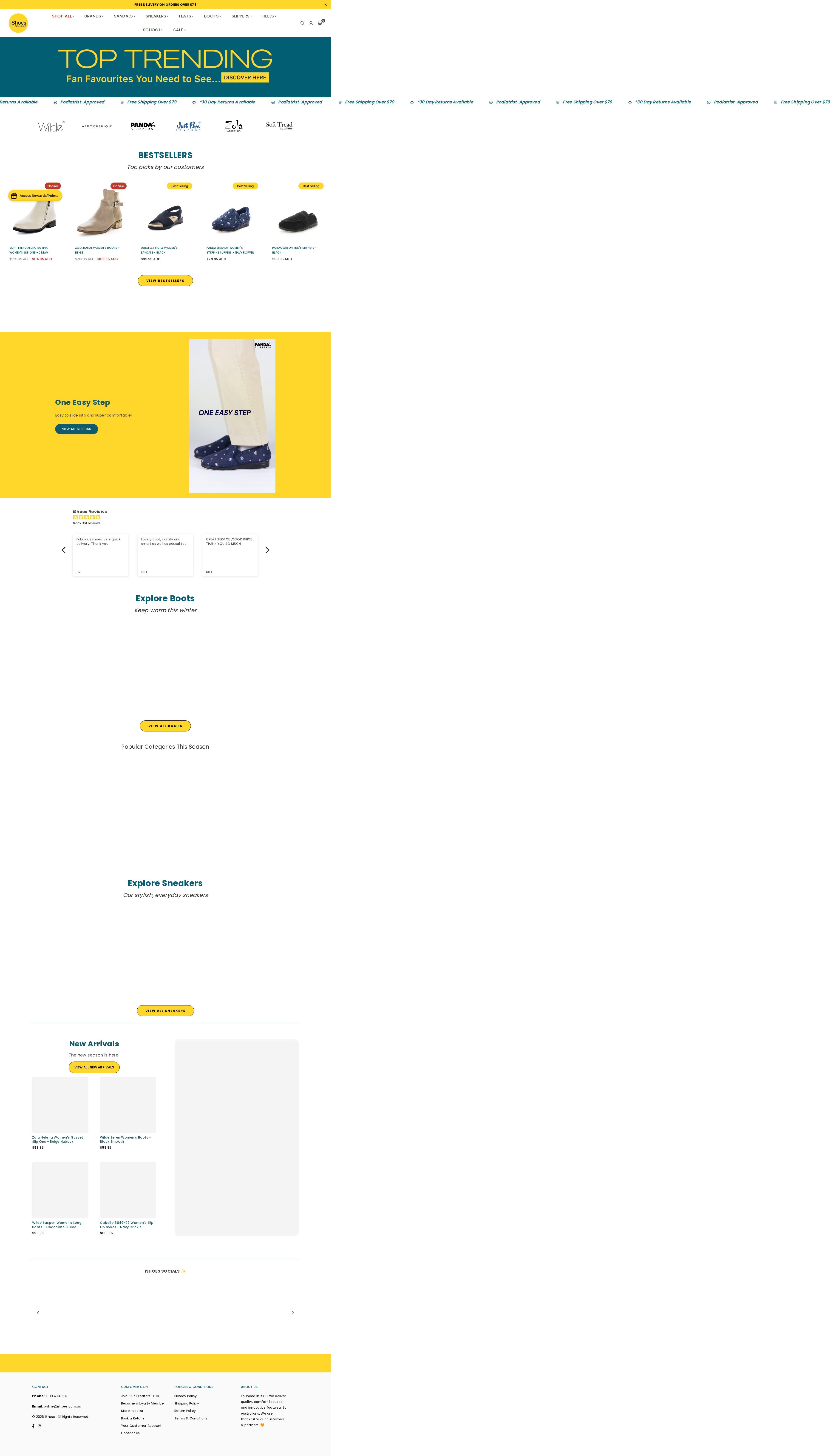
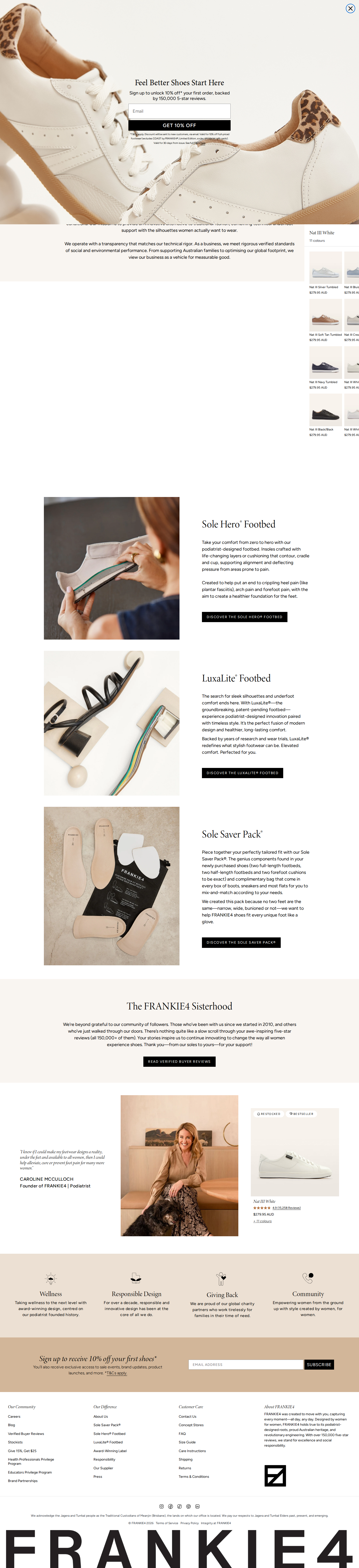
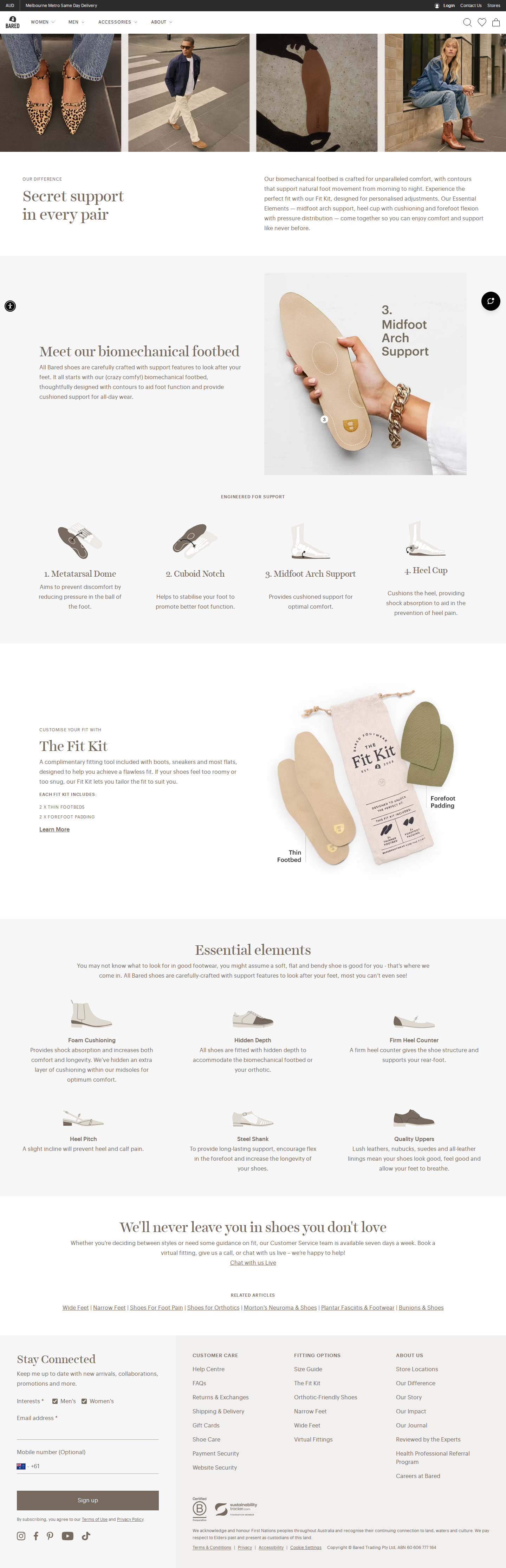
Where every number in this document came from
- Your Shopify
- Revenue, orders, products, customers, brands, categories and January. Read read-only through Shopify’s own admin interface. Pulled 11 and 12 August 2026, Melbourne (AEST). 27,372 orders in the file, 11,919 of them your own website.
- Refunds
- Every figure for what your shop sold is what a customer ordered, before any refund is taken off. Your own Analytics screen takes refunds out first, which is why it reads five to twelve per cent lower on the same window. We checked this directly, against a fresh pull of your order records on 14 August 2026 (AEST). Both figures are right. They are counting different things. It does not touch the Omnisend figures elsewhere in this document, which are a different system counting a different thing.
- Your Omnisend
- Sends, revenue, automations, campaigns, segments, unsubscribes and spam complaints, for iShoes and for Panda Slippers. Read live, 11 August 2026 (AEST), twelve months, brand time zone Australia/Melbourne. Omnisend counted the orders. Where a figure is per thousand sends, Omnisend counted and we divided.
- Your Google Analytics
- Visitor age and sex, and conversion by channel. Read 11 August 2026 (AEST). Age and sex cover only the visitors your analytics can identify, which is never everybody.
- Your Google Search Console
- Clicks and impressions by page, sixteen months to 28 July 2026.
- Your live websites
- iShoes, Panda Slippers and Just Bee, plus seven other Australian shoe shops, all read on 11 August 2026 (AEST) the way a search engine reads a page, with the page’s scripts switched off. iShoes was then walked again on 13 August 2026 (AEST) on a phone, the way a customer walks it, with everything switched on and every destination reached by tapping what was on the screen rather than by typing an address. Nothing was bought, no account was made, no form was sent and nobody at your business was contacted.
- Your own content
- All 120 articles in your archive, read in full.
- Named third parties
- Litmus, for the email survey, United States, November 2024. NP Digital, for the three AI search figures, and NP Digital sells these services. Published research on email frequency across 603,153 shoppers. None of these sets a bound, a target or a position anywhere in this document.
- Not measured, anywhere
- Lifetime value, which has never been measured on this account. Profit and margin, because no cost data exists in any pull we have. What your email programme costs to run.
- Not used
- Just Bee’s email figures, because Just Bee has no live email connection and every figure for it would be a June 2026 snapshot compared against a live August 2026 one. Any figure from the live sales dashboard, because it returned a wrong number.
- Register
- Australian English. Australian dollars unless a figure is explicitly marked United States dollars, and no exchange rate has been applied to anything. Times in AEST.
- This document
- Prepared by Raava for Fujian Footwear Australia, 16 August 2026, Melbourne (AEST). Every page is code: HTML, CSS and drawn shapes, with one exception — the live-companion page carries nine captures of real websites taken on 16 August 2026, stored as local files beside this document. It needs no network connection to open.
- Status
- A proposal. Nothing in it is agreed, approved, signed or in progress.